

Lauren Piovesan
Founder of ESL Reads
EAL Teacher
Recent Posts
Being able to communicate is power
Interesting, illuminating, but not too taxing
Breaking through Policy: Embracing Humanity in EAL Teaching
Understanding Ramadan and Eid: A Brief Guide for Teachers
Beauty Lies in a Hybrid Identity
5 Questions to Ask Yourself When Selecting Texts for Beginner EAL Learners
The invisible classroom: insights into working with young Afghan origin students
June 29, 2026
Words by Abdul, written by Lauren.
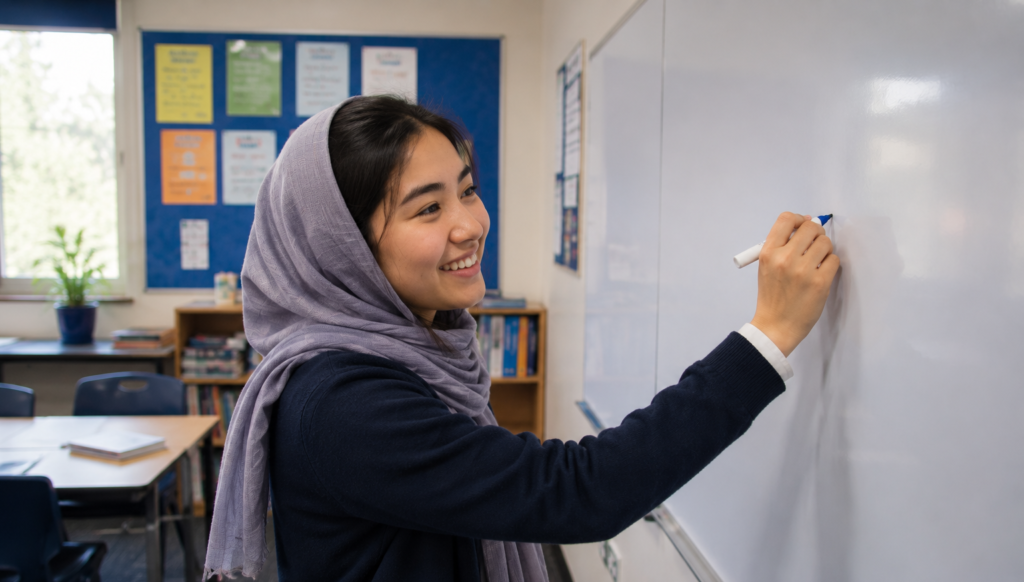
I was very fortunate to sit down with Abdul, a multilingual teacher aide who has been supporting newly arrived secondary-aged migrant and refugee students since 2010. Abdul, both through his own experience as a refugee, learning English, and now living in Australia for over 26 years, and in his incredible work supporting multi-ethnic EAL students (including linguistically through Dari, Hazaraghi, Farsi and Urdu) in the classroom for 16 years, has generously shared with me the invisible aspect of the Australian classroom. For this blog, Lauren’s words are in italics, and Abdul’s words in quotation marks.
This is a conversation I wish I had had before walking into any EAL classroom. I truly learnt so much from speaking with Abdul, and I’d love to share it with you in the hope that you will find it insightful too.
1. Who are our Afghan origin young people in the classroom and what does their educational history look like?
When talking about the schooling experiences of Afghan young people, Abdul spoke first about their heterogeneity.
“Afghans are not a monolith, they are not one kind of group. We are 17 different ethnic groups, 17 big ones, then there are a lot more small ones.”
And he reminded me about the subtext underlying education in Afghanistan.
“Education has been taken away since the invasion of the former Great Britain, then the Soviet Union, then the USA. We’ve not had a consistent, ongoing education system since the British Empire went into it. Every time, it destroyed our society and we kind of lost our identity. That’s the context of us breaking into a trillion pieces.”
Because of this, schooling experiences change depending on who you talk to, when they arrived in Australia and from where.
“Minorities didn’t have access to education, but if they had longer time living in other countries, some of them have had some level of basic education. And those who were more remote, it depends on how much was available to them. For the Afghans that mostly come to Australia, they are synonymous with refugees and their access to education was very poor.”
For those that have had experiences with schooling, it wasn’t always positive.
“While for some who had access to education, they were highly academic, motivated and keen to learn. There were others who were made fun of… thrown out of class or school or only there for one week. They started hating school because it became representative of bullying and rejection.”
These students were targeted for so many reasons.
“They were the wrong ethnic group in the wrong place. They were the wrong age for the wrong class. They were not long enough in that town to stay in school. They were not there long enough to make relationships in the town so that the principal allowed them to go to school. They were not rich enough to pay.”
Depending on these schooling experiences, our students enter our classrooms with different attitudes towards schooling.
“Some kids would have frowns for no reason and they would not engage. Or they want to be loud so you never get the chance to hurt them, they hurt you first. They are using learnt survival and defensive mechanisms.
Others are kind, profoundly interested, and profoundly curious. They make up a vast majority of girls who come from Afghanistan because education has been taken away from them for so long.”
And for the first year or so, our Afghan learners are either keen or scared…
“There is a massive overwhelming feeling whether you’re really scared and you don’t want to engage, or you are really keen.”
And a couple of years down the track…
“They understand the game and dance around how they want the teachers to hear them. They will speak how they want the teachers to hear and tell them what they want to hear. Because they are really street-smart, they know how to navigate it. At the beginning, they are keen with sincerity which can later become sarcastic or ingenuine.”
This street-smartness is their strength…right?
“Their ability to read the room, read the moment, read people is their strength. It’s been a survival mechanism because if they can’t read a situation, they are going to be screwed over. They can do this without knowing the language.
Of course, there are exceptions, some kids have had a really protected life because their parents have protected them from their experiences, and they are almost completely unaware of reality. It’s two extremes.”
And which other strengths should we recognise?
“Inherent resilience and resourcefulness because it’s in the culture and in the faith. They’re always resilient and strong (also known as stubborn or strong-willed!).
Afghans are also really expressive, linguistically elaborately happy and they always talk. That’s how they express themselves. It’s a very cultural thing to be poetic and expressive.”
2. What’s it like for our Afghan young people learning English in Australia and what’s challenging for them?
Abdul reflects on the idea that in the teaching of English, our learners can be subject to a demoralising and condescending experience. He points to the way we unconsciously use language in the classroom and how subtle shifts can make the world of difference in terms of providing a more dignified, inclusive and empowered learning experience.
“The challenges around acquiring the language insinuate that Afghan people are not complex enough, that’s why they came to Australia and that’s why they come here for a better life, that these people are not complex enough to learn the way we think. So that kind of demoralising and condescension is inner built, it’s in the bricks, it’s in the vine of every word. If you’re not conscious of it, it can just be a simple word.
For example, if a partner or friend said the same word they just said a second ago but said it with a little more cattiness or energy, you can feel whether it’s a fight or it’s joyful. You can feel it and also hear it. It’s a silent power that’s more powerful than the physical part of the word. These people are super in tune to that and they feel how genuine someone is.”
So, the tone and intention behind the language we use really matters.
“I would like you to see how you frame teaching the kids. It’s not that their English is wrong or that the words they say are wrong, it’s often framed that it’s them saying it wrongly. Do you know what it does to a young person who has been rejected from society? They are wrong all the time.”
To ensure it’s not framed in this way, we can say something like…
“Would you like to sound like a natural English speaker and practise with me? This is you practising your tongue, your muscles to sound like an English speaker. If you don’t, then you’re not going to speak in a way that you will be understood.” If I say that, everyone would be interested.”
So it’s about explaining the purpose of the activities and inviting students to make a decision to participate?
“Yes, it takes away the project of you’re dumb, you don’t know what to do, and you have to listen to me. I know best, you know nothing.”
This power dynamic is really important, especially when it comes to discussing classroom values or behaviour.
“Respect is very one way dominant in the classroom because the dynamic between the teacher and the student is massive. When teaching the concept of “respect” in the classroom, it’s insinuating that other cultures don’t know how to show respect. Instead, we can say, “How you respect and how we respect in this country is different. Let’s understand how we both practise respect. You teach me, I teach you.”
But we also have to be aware of the types of questions we ask in these learning environments. It might be quite unconscious and automatic for us to ask, “In your culture, do you do this?”
“These kinds of things are really harmful. The person who has no idea what their culture is because they’ve been running from place to place to survive…Imagine a young person who might have a different identity e.g. sexuality, gender, religion etc, for the receiving person, this question is giant. They are trying to find out what their culture is and where they are supposed to belong. This question really unravels a lot.”
This search for belonging sounds like an ongoing process.
“Yes, these kids really want to belong. But in many ways, you are never allowed to feel you are part of this society. I’ve been here for 27 years and I’m still asked where I’m from. There’s a general underlying aggressiveness in our interactions with Australian people and migrants and refugees respond to that in thousands of ways; quietness, aggressiveness, very loud, very dismissive, disengaged, very engaged, super interested, completely disinterested.”
3. What do teachers misunderstand about our young Afghan origin learners?
“There are lots. Eye contact is one of the biggest ones and it’s not just Afghan culture. The teacher asks the students to look at them when they’re talking. In most of their cultures, to not look is actually them showing respect. They’re not challenging the teacher’s authority.”
So when they’re being spoken to or told off, they look down and they might cross their arms.
“When they cross their arms, they’re holding their hands and arms because they don’t want to have any defence mechanisms. It means they have no weapons to hit or defend.”
And when Afghans get together, they talk.
“To think they need to talk, to talk they need to think. And when they talk, that’s when we know they are not only doing one thing, they are listening and talking. Loudness is part of the culture.”
This expressive and poetic nature of the language must make it difficult to interpret into English.
“I think the culture of every language is their soul and therefore it has a life to it. A lot of people interpret, but they only interpret the literal word, not the soul of the word. A lot of misunderstandings happen, interpreters and TAs have hand in it, because they choose to follow what is asked of them instead of what is asked of them to do for clients to understand.
Teachers often want the word for word. But if you’re trying to explain, or express something you have to give the soul, the autonomy and the subtext of the word all without making it into a story.”
4. What can we do in the classroom to better support our young Afghan origin learners?
1. Build class rules together
“When we start a term, we will sit down and write our own class rules, and all of us will hold each other accountable for that because this decision was made together. It’s more powerful because they no longer feel this rule is enforced upon them. They feel that they have communicated clearly what they want in the class. And when the kid misbehaves, you have to be really, really consistent. Pull them aside so they’re not reprimanded in front of a group. Point to the rules displayed. “Fatima, do you remember rule number 3?” There’s no need to go on a tangent. It becomes a really powerful tool. It becomes predictable, it’s self-explanatory. It’s a common language for the class.”
2. Reflect on the language you use in the classroom
As mentioned above, the way we speak, the intention and tone behind it and the words we use can either empower our learners or unravel them. Being conscious of what we’re asking given their context and experiences is crucial. This can include asking learners about their past experiences, countries, cultures, families and educational histories. Examples given above included:
- Asking learners if they “would like to sound like a natural English speaker and practise together?”
- Acknowledging that every student has an understanding of respect and saying, “How you respect and how we respect in this country is different. Let’s understand how we both practise respect. You teach me, I teach you.”
- Reframing questions such as, “In your culture, do you do this?” to avoid prodding at a young person’s developing sense of identity.
3. Stay neutral about a young person's cultural or religious clothing
“This is not just for an Afghan context but we have to remember that many refugees are persecuted for their faith. When they can be who they want to be, they make sure they show their faith and this can be through their clothing. The West has a mentality that if you’re wearing a mini skirt, you’re free. If you’re wearing a niqab, you’re not. But our students’ bodies are their private body, not public property for us to have an opinion on.
4. Connect with the parents/carers early
“Make time to talk to the parents, even if there’s an interview coming up, prior to that. Just call and introduce yourself, even just for 5-10 minutes. Tell them who you are, and what you’re thinking of doing with the child, and how you’re going to teach them and is there a suggestion they have? Imagine how many hundreds of minutes that would save you spending trying to communicate with the kid and families.
If you don’t spend this time, when we’re in crisis trying to call the parents, they are not going to be on your side because they’re suspicious of you. They will think, “You are just here because you need my help.” To spend the time means for them, “I have a job, you have a job, let’s do the job together. And I want to help you because you see me important enough or intelligent enough to engage with.”
In some cases, if you’ve got the parent, you’ve got the child.
“The kid is going to check if the parent and the teacher are friends. Some of them are super protective of their parents, especially those who experience war or domestic violence. They want to make sure you’re genuine.”
5. Teach your students how to think
“Teachers are always caught out about telling students to finish their work. They rarely ask, “What do you think? Is there something you would like to add? How would you do that? I would like you to think about it freely, translate it in your head, how would you answer it?” They don’t have to come up with any answer, but you give them the ability to think.”
Abdul’s insights are a powerful reminder that working with young refugees is about far more than teaching them the nitty-gritty and the mechanics of the English language. As teachers, we can remain curious, reflective and willing to learn alongside our students. Small shifts in the way we communicate, build relationships and interpret behaviour can have a profound impact on how welcomed, valued and understood our students feel.
About Abdul’s work
Abdul has been working as a multilingual teacher aide for 16 years. He supports newly arrived secondary-aged EAL students from a range of countries and ethnic backgrounds, but he linguistically supports Dari, Hazaraghi, Farsi and Urdu speaking students. He is equally invested in every single one of the EAL students he works with in the most practical way.